Just further to Xancudo’s comments…
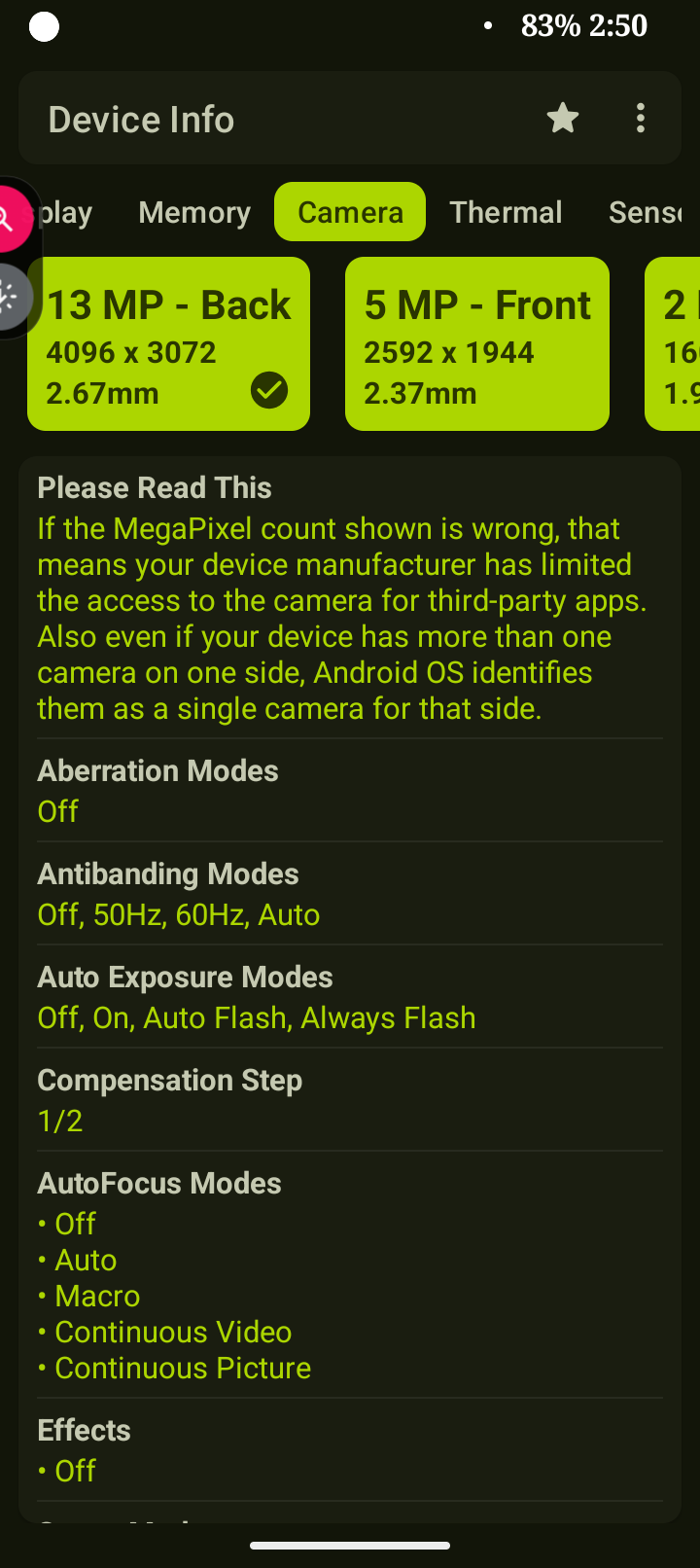
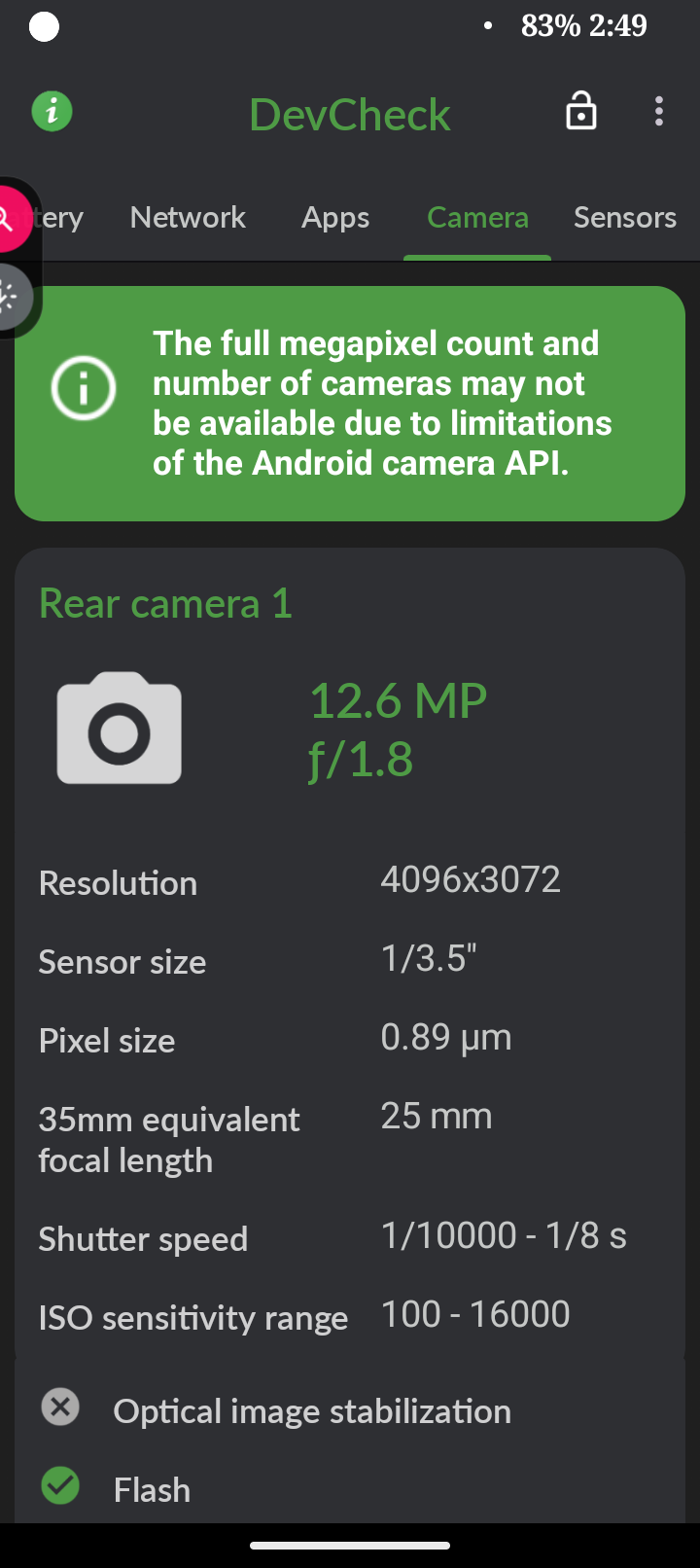
@plamen - I have two different deviceID apps that say the back camera is only 13 MP, not 50. Why is that?
Oh no! I only use my phone on speaker! This will be a major issue  i never put phones up to my head!
Damn! Hope not. Shall wait for this reply answer
I use a Faraday bag inside Ziplock baggy with my Pixel 6a running GrapheneOS. Some Pixels still leak water into the phone. This set up prevents my phone from alerting when I drive near well known retail stores. Outside of the Faraday bag I get alerts up to 1/4 mile away from the stores. I have No store apps. I do not like those “marketing” aka Spy apps.
2 Likes
What the app detects is the firmware/software for the camera. Can you share which deviceID apps are you running so I can check. Most likely the app just doesn’t recognize the software correctly.
I’m running Device Info HW (https://play.google.com/store/apps/details?id=ru.andr7e.deviceinfohw&hl=en) and it shows as 50MP.
But more importantly, you can see the resolution of the images taken. I’m using open camera on my BraX3, which let’s me manage the photo resolution easily. I’m able to set the resolution to 50MP for the rear camera.
4 Likes
The two I used are Devcheck and Deviceinfo. I downloaded the one you showed, and it does show 50.3. I guess they can’t read all the info correctly. I looked at some pics I took and saw that their info shows 50 also. Thank you sir.
3 Likes
That’s the most important. Cheers!
2 Likes
Just as an aside and FYI there is another thread somewhere that discussed camera resolution and image quality and I think suggested using Open Camera App and setting the rear camera resolution lower than 50MP to get better quality images…
See this thread if of interest:
3 Likes
Can we get an official CAD file for a PLA printed case that can be downloaded in 3MF format?
1 Like
This is a superb idea.
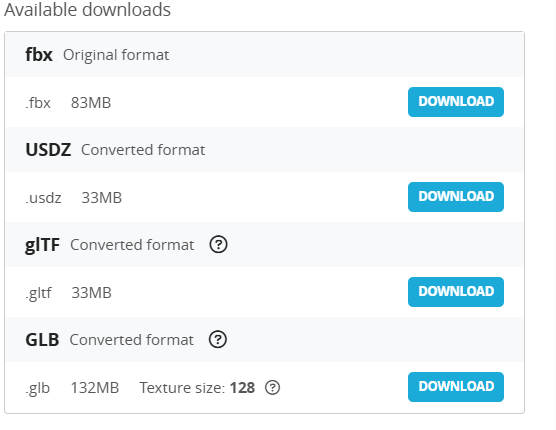
You will need to download the model in one of the 4 available formats first, and then find the software to convert the file format to CAD.
3 Likes
Does the Brax3 USB-C port support video output? I don’t see a USB-C Alt mode specified, so it doesn’t look like it does. Thanks.
1 Like
What are the supported Bluetooth audio codecs please?
1 Like
opus, flac, amrwb, aac, vorbis, g.711, aptx
I’ve just added those to the specs.
1 Like
Too bad the battery is fixed atlhough the first measure to avoid snitching by the phone is to cut the power.
I’ve been following videos on the Brax3 phone with some interest. Currently I have a Pinephone running Mobian Linux, purchased in late 2020. The Pinephone is a limited device in many ways that has been said to have a potato for a CPU. That is not far off, it is quite slow and what makes it even slower is the eMMC is connected via internal USB2. (It takes about a minute and a half to boot up when turned on.) The Pinephone is fine for primary phone and text communications, but pretty agonizing if you want to run something like Mozilla Firefox. Also the phone is only 4G, no 5G support (how much longer will 4G be around?), and WiFi is limited to the 2.4GHz band. Having said all this it does have some decent privacy-oriented features, and I’m wondering how the Brax3 compares.
The Pinephone has a removable battery (I’ve read the Brax3 does not), and when the phone is turned off it is OFF. This is confirmed by the fact that battery life with the modem active is pretty awful. If the Pinephone were phoning home while turned off the battery would be depleted very noticeably the next time it was turned on and this does not happen. (Battery life overall is not very good. However being removable and a standard Samsung size it’s easy to carry a charged spare battery.)
The Pinephone has hardware switches to disable modem, wifi, microphone, and cameras which is nice - you know if you throw the switch that part of the phone is definitely turned off. The modem is connected to the rest of the system via internal USB2 so is kept isolated from direct access to system memory. Partial open-source firmware with some extended capabilities is available for the modem. (The radio portion remains a binary blob.)
The Pinephone is supported by a number of Linux distributions that have various levels of functionality. It cannot run Android apps but I see that as a feature.  A plus is that anything one can run on a desktop Linux system will run on the Pinephone, within its hardware limitations. I’ve brought up a terminal, for example, and compiled applications from source directly on the phone. The phone can also be accessed via ssh. Full disk encryption can be used as on desktop Linux.
Spare parts are available and the Pinephone is modular construction. I managed to crack the screen early on but was able to order another at a reasonable price and replace it myself pretty easily, and have ordered additional spare parts to keep on hand.
Another nice feature of the Pinephone is that the IMEI can be changed pretty easily. I’m using it with a cell provider that says the phone is not compatible. However, I changed the IMEI to that of a compatible phone that I own and do not use. With the SIM card having been already activated the Pinephone has worked for years now with no problem. However I don’t know how much longer it will be viable and am looking at possible alternatives.
All this is not to promote the Pinephone but to try getting feedback on how the Brax3 compares, particularly in its privacy features.
2 Likes
@plamen
In Europe we also use 4G bands: 20 (800 MHz) and 32 (1500 MHz).
Is there a reason why these are not included in the spec list above?
If the only reason is that you’ve not included the RFE filters for those, then how can we replace the relevant filters to also support these bands? Will you provide an international version?
The reason is mainly limitations on CPU level. Only high-end/flagship CPUs (used on phones priced at 800$+ on average) can support true global band connectivity. The BraX3 CPU (Dimensity 6300) has a limitation on the number of bands supported on it. We tried to select the bands so that the BraX3 can provide decent connectivity at almost any point in the world. As a result we had to do some trade offs (e.g. not supporting verizon bands, dropping some other bands like the B20 and B32 you mentioned, etc.).
We’re not at the scale currently where we can support multiple variations of the BraX3.
2 Likes
I guess after that long post about how the Pinephone is set up I should have asked a few specific questions about the BraX3 phone.
- When the BraX3 is turned off, is the modem actually off, or does it continue to phone home? (This is particularly important since the BraX3 battery is not easily removable and there are no hardware switches to turn off the modem or other features.)
- Is the modem isolated from the phone’s main memory? (On the Pinephone this is accomplished by connecting the modem via internal USB.)
- How difficult is it to change the BraX3’s IMEI? (I ran across a post saying it is possible but may not be straightforward.)
- Can the BraX3 boot off a Micro-SD card to try out different operating systems as they become available? (With the Pinephone I can flash an SD card with an OS and the phone will automatically boot off it, so it is possible to try out an OS without disturbing the eMMC installation.)
- In the default BraX3 OS is full disk encryption (without Google or government back doors) available? (With the Pinephone and Mobian one can use LUKS disk encryption as on a desktop Linux system.)
3 Likes