Had the phone for a while and have no issue charging to 100% generally. I have recently started using a 5w wireless charge adapter. I went small to limit current and prevent overheating etc.
When used on a oppo, or motorola, it works fine and both phones charge to full. On the brax it only ever reaches 85%, no matter how long I leave it. If I return to a USB cable, it finishes the charge no problem back up to 100%.
All the battery settings are turn off, so no scheduling etc. I can’t understand why it won’t fully charge with wireless. It must be a setting yet the USB cable works. It doesn’t just crap out, its always exactly 85% so something deliberate is going on.
Brax3 draws more than 2 Amperes at 5 Volts which means 10Watts. Your charger gives a nominal 1 Ampere which will be actually around 0.8 Amperes before cut-off where the output voltage will have dropped much below 5 Volts, probably the other phones have some different charging controller, I suspect that your charger’s output voltage drops below the voltage of the battery at 85% but anyway it would be better to avoid charging beyond 90%
Thanks George. I deliberately went 5watt because many people were suggesting the 2A power was too great for the thin adapter ribbon cable and it was getting hot / resistive / disconnecting and reconnecting.
Was happy for a slower charge overnight. I guess I can try a 10watt and see what happens. Or just plug it in
In fact I haven’t studied the wireless charging but since it has an alternating current the power can be controlled by the frequency of the alternating current and the coupling between the coils, if you keep the phone at a distance of some centimeters from the charger there will be less inductive coupling, I don’t know whether this will be overloading the charger as it won’t be able to radiate all the energy but again the situation is similar like not charging anything
Cheers. I do have the phone in its rugged case too, which I expected to be an issue. I just got hopeful it wouldn’t block too much current when it started charging and gave me a time for full charge to be complete.
The specific 85% does logically seem to me to be a phone thing rather than a more general voltage drop issue. Maybe the charge profile changes at that point, and the new parameter can’t be met by the low input power?
The alignment of the coils is important too. The batteries charge at steady current up to 90% or something and then switch to steady voltage. I imagine that the case won’t be a problem at least if it’s not something very thick with decorations and maybe metallic parts.
Well thats it then I guess. When it switches to steady voltage the voltage drop is too low and it disconnects. The only thing left is a 10w adapter which others say has its own set of issues causing disconnects. Thanks for your help
I think I’ll just use the 5w for now and prevent overheating etc. Not ideal but gets me through the day. I’m sure I’ll tire of it eventually
I’m not too bothered by inefficiency. I’m off grid and make more power than I need. Again not ideal in principle, but I make enough to power the house and charge a car, so losing a bit whilst phone charging is fine
Got you - yes ditto, I make good power from solar myself and can go voluntarily off grid <90% of the year overall if I wish (100% in Summer/Autumn), but typically I feed my surplus back to the grid for some pocket change…
The only thing to think about with the 5W power source is whether that low output is actually bad for the battery longer term. I always had the impression low current can be damaging to batteries and cause a form of ‘brownout’ effect - that’s why I thought it’s always better to have an ‘over spec’ charger than an ‘under spec’ one… But I’m not an electrician and obviously someone like @george above, or similar will probably know much better than me; and it may be different for lithium batteries in electronic devices versus more traditional batteries (especially the big industrial ones I’m familiar with in forklifts and similar MHE).
Yeah i don’t know enough to be sure. My understanding is that low charge current is ok but slow. But attempting to draw more current than is comfortable comes at the expense of voltage drop, which stops the charging. Charging lithium to 85% should prolong battery life.
My wall wart is 10w and the charger is more than that. So the weak point is the phone pad.
I’ll put it in the ‘1st world problem’ box and return to the real world
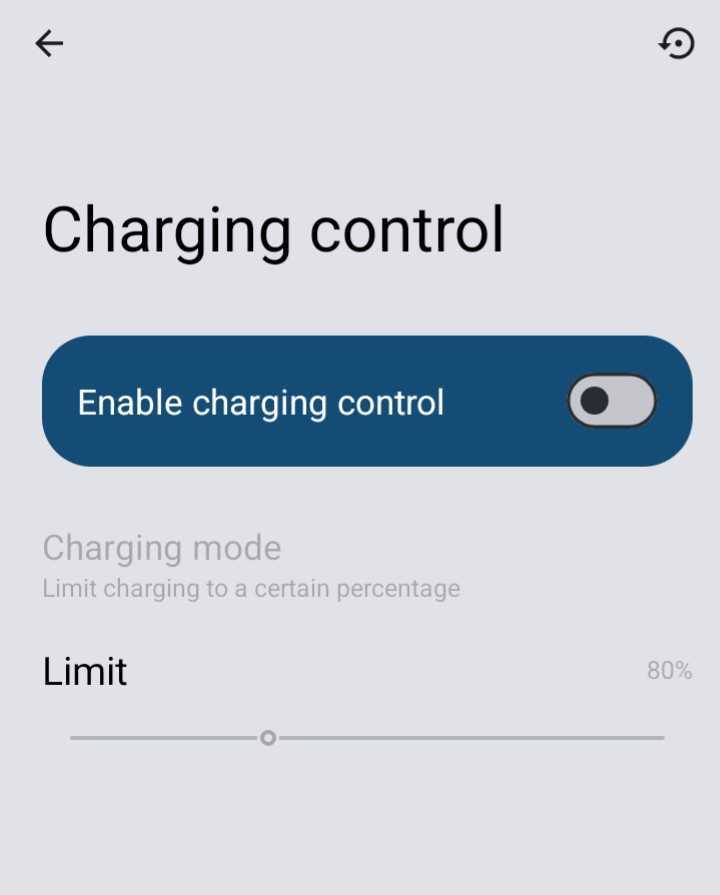
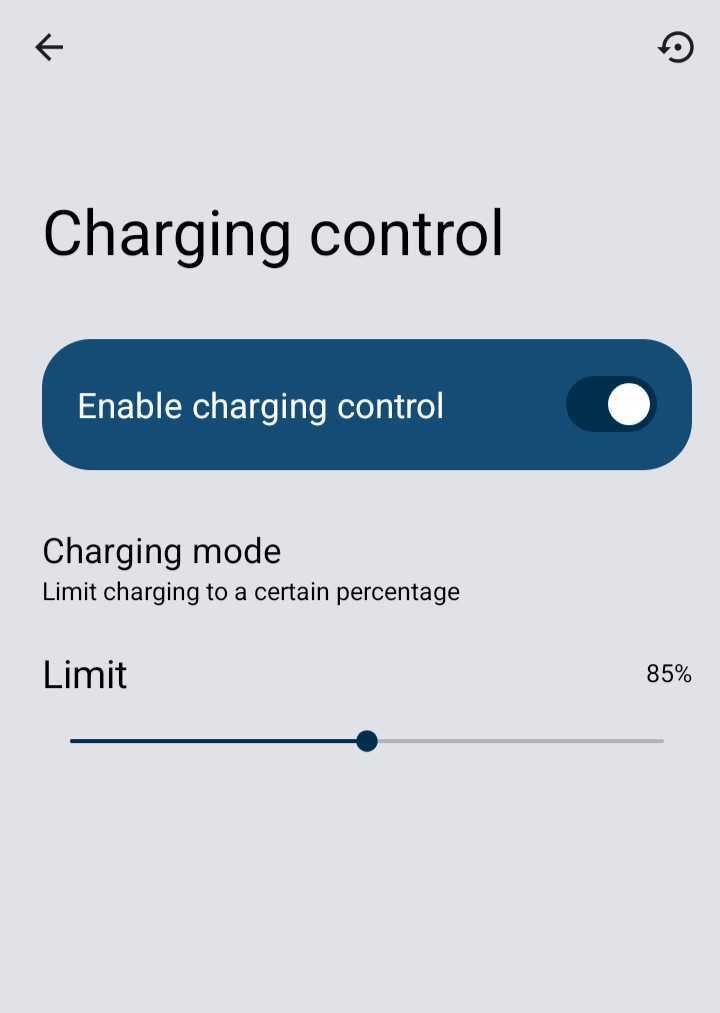
@Sparkie If you go to Settings → Battery → Charging Control
(or just search for “Charging Control” in settings)
You should see one of the following screens. Is it possible that you have charging control enabled? If so you can adjust the limit or just turn it off completely.
Thanks inverdell. I did check that and all battery settings are off.
Ive got two chargers, 2 adapters, and 2 separate wall warts, with 2 different phones. The other phone charges fine, just not this one. But. I did try the brax on the other charger and it went from 85 to 100%. So I’ll run it down a bit and see if it charges correctly on the other set up. The wall warts are both rated the same, but just maybe I’ll have a win
Well, I think I can mark this as solved. Not sure I understand why though.
After fluffing with various variables, the common point of failure between the brax stopping at 85% and other other phones getting to 100% was the 240vac-5vdc brick. But the one that works is only 5v 1A, not higher output as I’d have expected to be needed. All the others were 5v 2A, which the brax didn’t like.
If its not that, its possible that the brax only reaches 100% wirelessly if its on the left hand side of the bed, when viewed from the foot end
You can get voltage and current measurements, neither the nominal values are precise nor the behaviour of the chargers especially near its full power output. They have controllers inside that change the pulse frequency of the inverter transformer according to the demand and the input voltage from the wall. There is someone on YouTube who tests the chargers up to the short-circuiting cutoff and then disassembles them to check the quality. In the case of wireless charging you might have some magnetic or conductive object at the one side of the bed that interferes with the fields.